The company had received a loan restructuring package from banks under the 5/25 scheme last year.

As record stock market rally continues, the value of shares directly owned by next-generation business leaders at 20 major corporate houses has soared over 18 per cent to Rs 17,000 crore.
While the company insisted it had enough spectrum across circles, analysts said the company might soon need to acquire some spectrum to ensure uninterrupted service.

Finance Minister Nirmala Sitharaman on Tuesday unveiled a Rs 39.45 lakh crore Budget with a view to fire up the key engines of the economy to sustain a world-beating recovery from the pandemic. This was Sitharaman's fourth Budget. While the taxpayers were left in the lurch, once again, was she able to cheer Corporate India?

In the Union Budget presented in Parliament by Finance Minister Nirmala Sitharaman, a total of Rs 1,52,369 crore has been set aside for capital expenditure that includes purchasing new weapons, aircraft, warships and other military hardware.

As temperatures soar across the country, amid searing heat wave, analysts see power demand hitting fresh record highs this year. The time, therefore, may be opportune to add related stocks on dips as higher demand boosts earnings visibility, they said. On April 18, India's electricity demand touched a new high of 216 gigawatts.

'The IOC was not consulted about the OCA decision with regard to the Asian Winter Games and was not involved in the decision-making process.'

Ajit Mishra, vice president, Research, Religare Broking, answers your queries:

The 30-share Sensex, after opening on a strong footing, continued its upward march to hit an all-time high of 35,827.70. The NSE Nifty also hit a record intra-day high of 10,975.10, before finishing at 10,966.20, up 71.50 points.

As many as 2,000 chips are annually designed in India by semi-conductor and fabless companies, Intel India managing director Prakash Mallya said in a conversation with Business Standard. Mallya was reiterating the importance of India in the semi-conductor sweepstakes. "As much as 90 per cent of the semi-conductor companies have a design footprint in India.

Prime Minister Narendra Modi is likely to urge Tim Cook to begin manufacturing its prized iPhones in India.

It, however, remains to be seen how much money Softbank actually puts in, what the implied equity valuation is and if the e-commerce venture is included in the Jio entity.

Reflective of the conglomerate's ambition to turn into a consumer-driven business, most of the 33 acquisitions in the last financial year were for its digital, retail, or related verticals.

It boosts confidence to investors sitting on the fence.

The top losers from the Sensex pack are ONGC, Coal India, Vedanta, Reliance Inds and L&T.

Around 15 years ago, when Reliance Industries (RIL) struck natural gas in the Krishna-Godavari (KG) basin off the east coast, the government made plans to supply that fuel cheaply to scores of generators that sprang up in India triggered by the discovery. Most of the plants, which account for 6 per cent of India's total generation capacity, operate sparsely after the KG-D6 area first failed to meet production targets, and then finally shut shop. Affordable domestic gas was why those thermal plants came up and the rate of the fuel today is why those generators hardly operate. Record liquefied natural gas (LNG) rates may yet again unravel India's ambitions to expand use of gas in industries, households and vehicles. Rates, while volatile, may stay strong this decade as developed nations with higher purchasing power embrace gas as the transition fuel.

Participants are keenly waiting for the January IIP.

Prime Minister Narendra Modi on Thursday launched the ambitious 'Make in India' campaign to make India a global manufacturing hub, create jobs and boost economic growth.

The combined interest payment for India's top listed companies, excluding financial and oil and gas firms, was up 15.2 per cent year-on-year during the six months ended March 2019, outpacing the change in net sales and operating profit.
It would be a difficult task for the Indian economy to reach the $5-trillion mark a year before the International Monetary Fund (IMF) projection of 2026-27. Pankaj Chaudhary, minister of state for finance, said in the Rajya Sabha on Tuesday that the government is taking steps to make the country a $5-trillion economy at a date earlier than the IMF's projection. In that context, it would not be difficult to meet the projection in the third quarter of FY27.

In March this year, Worldline India launched Vabox (Voice Alert Box): merchants will now get instant audio alerts on the settlement of UPI (Unified Payments Interface) payments via QR codes in languages of their choice when customers check out. "They needn't worry whether the amount has been credited to their account," says Gulshan Pruthi, the firm's executive vice-president. The French payments giant will roll out 500,000 Vaboxes in the initial phase.

India will need $223 billion of investment to meet its goal of wind and solar capacity installations by 2030, according to a new report by research company BloombergNEF (BNEF). The government has set a target of increasing non-fossil power capacity to 500 GW by 2030. It wants non-fossil fuel power sources to provide half of its electricity supply by 2030. "To achieve this target, India needs to massively scale up funding for renewables," the report said, adding that $223 billion is required over the next eight years just to meet the solar and wind capacity targets.

It emerges that Vi has probably offered good data quality despite being short on spectrum and infrastructure due to its stretched finances. Did the two companies that merged face the heat due to price wars? Probably. Did the government's tough stance in demanding its "due" share of telecom revenues hurt the company? Certainly!
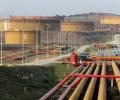
The length of the main trunk pipeline is 1,385 km from Kakinada to Bharuch and 75 km is the length of the spur lines.

The recent Indian telecom spectrum auction will hasten industry consolidation, strengthen tariffs and reduce regulatory risks.

Fresh buying by domestic institutional investors and better-than-expected June quarter results from some blue-chip companies boosted investor sentiment

Unlike the race to buy airwaves by telecom companies, airports by infrastructure companies and city gas networks by energy companies, the race to develop super apps by consumer-facing companies in India has not brushed up against any regulatory issues. Officials at the ministry of electronics and information technology and at other regulators are happy they do not have to meddle in who among the Tata group, Reliance Industries Ltd, Flipkart or Paytm will manage to build an app that sweeps in customers. Unlike separate apps a customer uses on her mobile to order groceries, buy food or airline tickets or just make payments, a super app can perform all these functions.

As deputy governor, Patel headed the RBI panel to draft the monetary policy report, which became the basis of the ongoing reforms at the apex bank

No longer Bengal's finance minister, Amit Mitra, Mamata's principal chief advisor, will still advise and aid the 'chief minister and finance department on all matters relating to management of state finance', represent the 'state government in national and international events/meetings/committees' and examine 'important proposals/files and policy issues relating to financial matters referred to him for advice/views'.

Companies announce Rs 768 bn worth investments in Dec quarter versus Rs 1.15 trn in Sep quarter

Banks do extensive investigation before declaring an account fraud; they owe it to us as they deal with our money. Why would they try to fix an innocent borrower? asks Tamal Bandyopadhyay.

Parliament has cleared the Mines and Minerals (Development and Regulation) Amendment Bill, 2023, recently. The objective of the Act is to invite investments from the private sector, including foreign companies, for mining minerals such as lithium and other critical minerals. Other than lithium, some of these minerals were classified as atomic minerals, including beryl and beryllium, niobium, titanium, tantalum and zirconium.

The fall in metal and mining stocks comes on the back of weak Chinese trade data

The success of Anil Ambani's ambitious defence plan will depend partly on whether he can persuade government officials and international partners that he can build sophisticated equipment and partly on whether the PM can get India's notoriously slow procurement process to work, say Paritosh Bansal, Sanjeev Miglani and Promit Mukherjee.

The reason is believed to be a 19% increase in interest cost.

Ajit Mishra, vice president, Research, Religare Broking, answers readers' queries on stocks they own or want to buy.

The case may drag for a few years, experts say, as CAIT and DVM have said they will appeal against the interim relief granted to Amazon.

If Modi rethinks on pro-biz policies, investors will suffer.

The combined networth of India's 100 wealthiest is $381 billion (nearly Rs 25.5 lakh crore), a rise of 10 per cent from $ 345 billion in 2015

In January, Visa's chief executive officer, Al Kelly, said during an earnings call that "there's been a burst of the balloon in valuations in the fintech world". Noting that the trend of lower valuations "is a helpful characteristic of the current environment", he added: "We will look for capabilities and management teams that will bring more value to Visa than we can bring ourselves." Data from KPMG's Pulse of Fintech H2'22 shows that global fintech investment - via mergers and acquisitions (M&As), private equity (PE) and venture capital (VC) firms - at $164.1 billion in 2022, was down 31 per cent over the year before. Indian fintechs held up better during this timeframe, attracting $6 billion, or a fall of 24 per cent.
 © 2026 Rediff.com - Advertise with us - Disclaimer - Privacy Policy - Sitemap - Feedback - About us - Terms of use - Grievances